
Associations between diabetes & depressive symptoms across European countries: A HRB-funded secondary analysis of ELSA, TILDA, and SHARE datasets
Overview
Diabetes impairs the body’s ability to properly metabolize blood glucose, and it is a common condition with a global prevalence of approximately 10.5% among people aged 20 to 79. Living with diabetes requires constant management, as individuals must monitor blood sugar levels, adhere to medication regimens, and make daily lifestyle adjustments. The ongoing demands of diabetes care can create significant stress, which may, in turn, contribute to the development of depressive symptoms.
People with diabetes are found to be at 2-3 times higher risk of developing depression compared to those without the condition. Depressive symptoms themselves are varied and can include a lack of energy, negative mood, sleep disturbances, loss of appetite, and anhedonia.
Several systematic reviews and meta-analyses suggest that depression is also a risk factor for the onset of type 2 diabetes.
There is a well-documented comorbidity between diabetes and depression: the physical and emotional challenges of managing diabetes can elevate stress, which may exacerbate feelings of depression. Conversely, depression can worsen metabolic control, making it harder to manage blood sugar levels and increasing the risk of diabetes-related complications. This bidirectional relationship creates a cycle, where the impact of one condition can perpetuate the other, complicating both mental and physical health.
Research Focus
This study aims to combine data from large European research studies to achieve the following goals:
- Examine the relationship between depression and diabetes across different European countries, focusing on how the presence of one condition may increase the risk of developing the other over time.
- Identify country-specific factors (e.g., Diabetes care provision, access to mental health services) and individual-level factors (e.g., health behaviours) that may explain variations in depression-diabetes comorbidity across regions.
Importance/ potential implications
Both diabetes and depression are significant global health burdens on their own, and together, they pose even greater threats. By understanding the predictors of international differences in the two-way risk of developing both depression and diabetes, this research has the potential to shape future public health interventions, both in Ireland and internationally. The study will also provide insights that could inform policymaking and help develop targeted mitigation strategies—insights that would be difficult to achieve through individual country studies alone.
Methodology
This study will utilize data from The Irish Longitudinal Study on Ageing (TILDA) and public datasets such as The English Longitudinal Study of Ageing (ELSA) and The Survey of Health, Ageing and Retirement in Europe (SHARE). It will apply survival analysis to predict when diabetes may develop in people with depressive symptoms and vice versa, across different countries. Additionally, multilevel models will be used to assess the two-way risk of developing both depression and diabetes, both within individual countries and across different countries. The study will also identify the key factors that influence this comorbidity.
Findings
The findings of this study have not yet been published. Please revisit this page to stay informed of the findings from this study directly from our research team.
Other disseminations
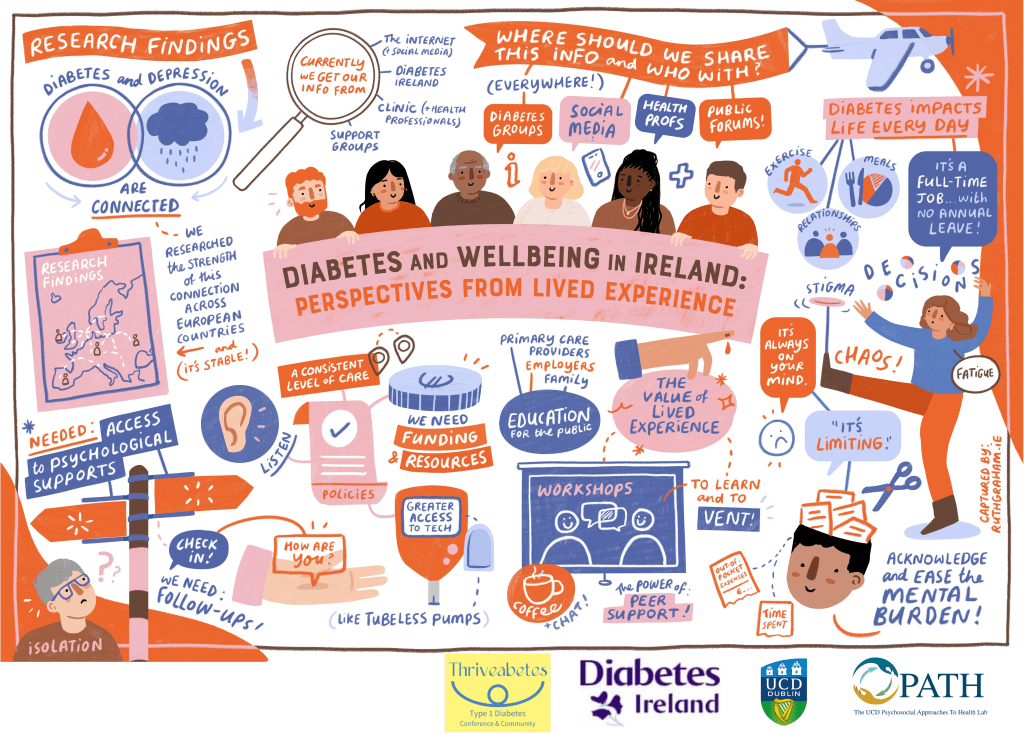
As part of this project, our team hosted two co-creation workshops in Dublin and Limerick titled “Diabetes and Wellbeing in Ireland – Perspectives from Lived Experience” in April.
These sessions brought together people living with diabetes to reflect on some of our recent study findings exploring the link between diabetes and depression, and to share their broader experiences of diabetes and wellbeing in Ireland.
The workshops are part of a larger HRB-funded study on diabetes and depression co-morbidity, and were designed to:
– Gather lived-experience reactions to key findings
– Explore emotional and mental health challenges faced by people with diabetes
– Identify meaningful ways to communicate research with both scientific and public audiences
We were also joined by a graphic recorder, who visually captured key themes and conversations from both days. The illustration below brings together participants’ insights in a powerful and accessible way.
Learn More
If you have any questions or would like more information about this study, please contact:
Dr Sonya Deschenes,
Assistant Professor,
UCD School of Psychology
Email: sonya.deschenes@ucd.ie
or
Dr Jaroslav Gottfried,
Post-Doctoral Researcher,
UCD School of Psychology
Email: jaroslav.gottfried@ucd.ie


 The UCD PATH Lab